
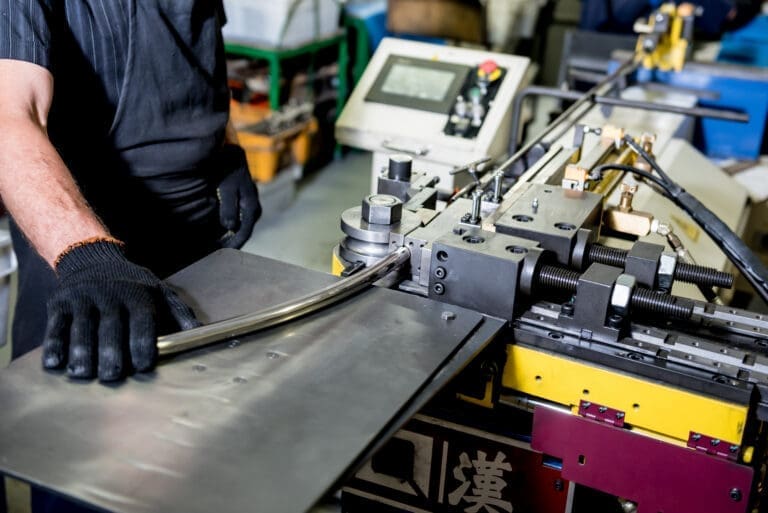
Aerospace tube bending sits at the center of how modern aircraft systems are designed, routed, and assembled. Tubing is not just a structural afterthought, it is a primary medium for transporting fluids, controlling motion, and maintaining environmental conditions across the aircraft.
Across platforms, tubing supports:
- Hydraulic lines that drive flight control surfaces, landing gear, and braking systems
- Fuel delivery systems that move fuel safely from storage to engines under varying pressure conditions
- Environmental control systems (ECS) responsible for cabin pressurization, temperature regulation, and air distribution
- Reduced system integrity due to fatigue or microfractures
- Increased weight from overdesign or additional supports
- Non-compliance with strict aerospace safety requirements
Aerospace Requirements That Change How Tubes Are Bent
Tight Tolerances and Repeatability
Aerospace systems demand extremely tight dimensional control. Even small deviations can cause misalignment during installation or interfere with adjacent components. Typical aerospace tolerance expectations are significantly tighter than general industrial fabrication. This affects:- Fitment within constrained assemblies
- Alignment with fittings, valves, and connectors
- System consistency across production batches
Material Challenges
Aerospace tube forming involves materials that behave very differently from standard carbon steel. Common materials include:- Titanium
- Inconel
- Stainless steel
- Aluminum alloys
- Springback: High-strength alloys resist deformation and tend to return toward their original shape
- Work hardening: Repeated deformation increases material hardness, making further forming more difficult
- Cracking risks: Improper tooling or bend radii can lead to fractures, especially in brittle or high-strength alloys
Regulatory and Quality Standards
Aerospace tubing production operates within a heavily regulated environment. Key frameworks include:- AS9100 for quality management systems
- NADCAP accreditation for special processes
- Full traceability requirements for materials and production steps
Core Aerospace Tube Bending Processes
CNC Tube Bending
CNC tube bending is the backbone of modern aerospace tube forming. Multi-axis machines control bend angle, rotation, and feed with high precision. This allows:- Complex multi-plane geometries
- Consistent replication across batches
- Integration with CAD/CAM systems for digital workflows
Rotary Draw Bending
Rotary draw bending is widely used for tight-radius applications where dimensional accuracy is critical. This process relies on:- Mandrels to support the tube internally
- Wiper dies to prevent wrinkling
- Precision dies matched to the tube diameter and material
Roll Bending and Large Radius Forming
For larger structures or gradual curves, roll bending is used. Applications include:- Structural tubing
- Frame components
- Large-diameter systems
Preventing Failure: Key Engineering Considerations
Wall Thinning and Ovality Control
During bending, the outer wall stretches while the inner wall compresses. This leads to:- Wall thinning on the outer radius
- Ovality (loss of circular cross-section)
- Proper mandrel selection
- Controlled bend radii
- Material-specific process parameters
Springback Compensation
Springback is a constant challenge in aerospace tube forming. High-strength materials resist deformation, requiring over-bending to achieve the final geometry. Accurate compensation depends on:- Material data
- Bend radius
- Machine calibration
Surface Integrity and Contamination Control
Surface condition matters, especially in fuel and hydraulic systems. Contaminants or surface defects can lead to:- Flow disruption
- Corrosion initiation
- System contamination
Tooling and Automation in Aerospace Tube Bending
Precision tooling is the foundation of successful aerospace tube bending. Core components such as mandrels provide internal support during the bend process, helping maintain wall integrity and preventing collapse. Dies are carefully matched to both the tube geometry and material, allowing for accurate forming without introducing defects. Clamping systems play an equally important role, holding the tube securely in place while maintaining alignment and minimizing deformation throughout the bend cycle. Automation builds on this tooling foundation by reducing variability and increasing throughput. By limiting manual intervention, automated systems produce more consistent output across shifts and production batches. This level of control also enables faster cycle times, allowing manufacturers to meet production demands without compromising dimensional accuracy or repeatability. Integration across fabrication workflows adds another layer of capability. Tube bending systems are often connected with upstream and downstream processes, including laser cutting for pre-processing, end forming equipment for creating fittings and connections, and inspection systems for validation. UTE’s equipment ecosystem reflects this integrated approach, combining CNC tube bending, fiber laser cutting, and automation into a cohesive production environment designed to support efficient, high-precision manufacturing.The Role of Tube Bending in Aerospace Manufacturing Efficiency
Reducing welds is one of the most direct benefits of aerospace tube bending. Fewer welds mean:- Lower leak risk
- Reduced inspection requirements
- Simplified assembly
- Lower overall aircraft weight
- Improved fuel efficiency over time
- Prototype development with rapid iteration
- High-volume manufacturing with consistent output
Challenges in Aerospace Tube Forming (And How to Solve Them)
Aerospace tube forming is not without its challenges: Complex geometries require multi-plane bending and precise sequencing. This is addressed through advanced CNC control and simulation. High material costs make scrap reduction a priority. Accurate first-pass bending and process validation reduce waste. Balancing precision with production speed is an ongoing challenge. Automation and optimized workflows help maintain output without sacrificing quality. Skilled labor gaps are becoming more pronounced. Modern equipment reduces reliance on manual expertise by embedding knowledge into machine control systems. Dealing with complex geometries or tight tolerances? UTE can help you build a system that fits your exact requirements. GET STARTEDHow Advanced Equipment Improves Aerospace Tube Bending
Modern aerospace tube bending relies on high-precision equipment designed for repeatability and control. Key capabilities include:- Multi-axis CNC systems for complex geometries
- Real-time feedback systems that adjust during bending
- Software-driven simulation for validating bend sequences
- Reduce trial-and-error during setup
- Maintain consistency across production runs
- Transition more easily between low- and high-volume work
UTE’s Approach to Aerospace Tube Bending Solutions
Universal Tool & Engineering approaches aerospace tube bending from a practical, production-focused perspective. Rather than offering one-size-fits-all equipment, UTE develops systems tailored to specific production environments. This includes:- Configurable NC tube bending machines
- Integration with fiber laser cutting systems
- Automation designed around real-world workflows
- Precision in complex geometries
- Repeatability across production runs
- Scalability from prototype to full production
- Installation and commissioning support
- Hands-on training for operators
- Ongoing service from U.S.-based technicians