
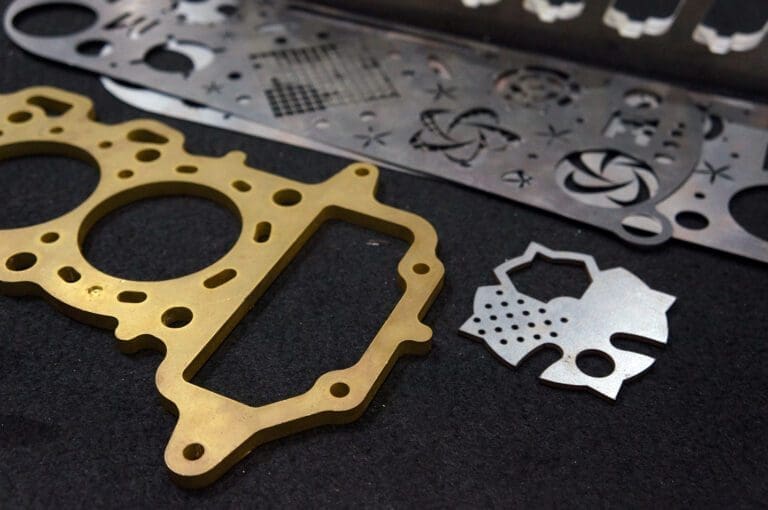
Not all metal cutting lasers are made equal, but the same can be said about the materials that they’re used to process. Choosing a particular metal can make or break a laser cutting job, but with so many options available, how do you pick one? Whether you’re a product engineer wanting to explore your options or a new laser cutting facility looking to supply the best options for your customers, this guide is meant to highlight the importance of metal selection and share our top 5 metal recommendations for fiber laser cutting.
Why Metal Selection Matters
While different families of metals share many similarities, it’s their differences that determine which exact metal or alloy will be the right choice for your next job. Here are a few factors to keep in mind when making your material selection for a laser cutting project or job.
Metal Properties
While some material features like thickness can vary from project to project, there are some inherent physical properties to consider when selecting a specific metal or alloy.
One of these properties is reflectivity. Highly reflective metals like aluminum, titanium, and copper can present challenges when working with older-generation CO₂ metal cutting lasers by disrupting the laser beam. However, with today’s fiber laser cutting machines, reflectivity becomes a non-issue.
What does remain a challenge regardless of laser type is a metal’s thermal conductivity. A metal with high thermal conductivity may require greater energy input to compensate for heat dissipation. At the same time, excess heat input can lead to warping and discoloration. Materials like aluminum, a highly conductive metal with a low melting point, can be especially tricky to work with. Heat input must be managed carefully to achieve the right balance between cut speed and edge quality.
Material Costs
Of course, cost is another factor that can’t be overlooked. Metal costs can vary greatly depending on a broad range of market factors, most notably including tariffs here in the U.S. as of lately. The cost of the material you choose will influence the price you’re able to bring to market, which can have an impact on your sales and profitability as a result.
Machine Wear
Although metal selection doesn’t directly affect the quality of the final part, each type of metal will require specific machine settings to achieve your desired results. As an example, you can’t cut stainless steel and copper on the same settings and expect the outcome to be the same. The material’s thickness will also determine what your laser setting should be, with thicker materials demanding higher power to achieve a clean cut all the way through. It’s also important to consider that your material of choice will have varying effects on your machine lifespan. A machine that cuts ¾” stainless steel plates all day long just isn’t going to last as long as a machine that cuts only a few 26 gauge aluminum pieces every hour.
Fiber lasers can cut faster and last longer compared to CO₂ and diode lasers. See for yourself what a fiber laser can do.
WATCH THE VIDEO
Best Metals for Laser Cutting
So, what are the best metals for laser cutting? We’ve gathered 5 metals that are highly compatible with laser cutting, and are commonly used to produce high-quality laser cut parts every day.
Stainless Steel
With corrosion resistance baked in, stainless steel is an excellent metal choice for many practical and decorative applications alike. With stainless steel, it is relatively simple to produce clean, high-quality edges when using a fiber laser even at higher thicknesses.
Mild Steel
If affordability or durability take precedence over corrosion resistance, mild steel (also called low carbon steel) can be a viable choice. Like stainless steel, low carbon steel is fairly easy to cut with any metal cutting laser.
Aluminum
Although challenging to cut on more traditional CO₂ and diode lasers, aluminum cuts exceptionally well when using a fiber laser machine. Aluminum is lightweight, strong, and easily recyclable, making it a smart and sustainable choice for both structural and decorative components.
Copper & Brass
Similar to aluminum, copper and copper alloys like brass have become much more accessible to laser cutting with the widespread adoption of fiber laser cutting technology. Although highly reflective and thermally conductive, these metals can be cut carefully with high precision fiber lasers.
Titanium
Titanium boasts the highest strength-to-weight ratio on this list—but also the highest price tag. Best reserved for specialty applications where strength, weight, corrosion resistance, and biocompatibility play a role, titanium sheets can be laser cut much more easily than they can be stamped or otherwise cut mechanically.
Want to try before you buy? Let us run a test cut on a sample of your material, free of charge.
BOOK A DEMO
Are There Any Metals to Avoid?
If you’re wondering which metals to avoid laser cutting, the answer is going to depend on your machine.
If you’re using a diode laser or CO₂ laser, you’re going to want to stay away from any highly reflective metals. Aluminum and copper struggle to absorb the laser wavelengths produced by these machines due to their own reflectivity, so they are decidedly out. Diode lasers and CO₂ lasers are more or less limited to ferrous alloys like steel.
A fiber laser is a different story. There’s not much that it can’t do. Fiber laser machines can cut through all of the metals listed above with ease.
Regardless of setup, there are naturally some metals that you will want to avoid due to intense adverse health risks. These metals include:
- Lead
- Beryllium Copper
- Chrome/Chromium
Metal Laser Cutting FAQ
Q: What metals are easiest to laser cut?
A: Stainless steel and carbon steel.
Q: Can aluminum be laser cut?
A: Yes, but fiber lasers handle it best.
Q: What’s the maximum steel thickness for laser cutting?
A: Varies by machine, commonly up to 1” (25 mm) with high-power fiber lasers.
Q: Is laser cutting better than plasma cutting?
A: For precision and fine edges, yes. Plasma can be faster on very thick materials but is better suited to rough cuts.