
Modern metal fabricators are under constant pressure to increase throughput, reduce labor dependency, minimize floor space, and handle a wider variety of customer requirements. As product mixes become more complex, manufacturers are increasingly evaluating ways to automate both sheet metal and tube processing within a single production environment.
For many shops, this raises an important question: Should sheet and tube laser cutting remain separate operations, or can they be successfully integrated into a single automated workcell?
This definitive guide explores the technical considerations, automation challenges, workflow implications, and practical evaluation criteria manufacturers should understand before investing in sheet and tube laser automation.
What Is Sheet and Tube Laser Automation?
Sheet and tube laser automation refers to the integration of fiber laser cutting systems, material handling equipment, software, robotics, and production workflows to automatically process both flat sheet metal and tubular materials with minimal operator intervention.
Traditionally, fabricators relied on dedicated sheet lasers and dedicated tube lasers operating as separate manufacturing islands. Today, manufacturers are increasingly exploring:
- Automated sheet loading and unloading
- Tube loading systems
- Robotic material handling
- Integrated nesting and programming software
- Combo sheet-and-tube laser systems
- Connected manufacturing cells
The goal is simple:
- Increase machine utilization
- Reduce labor requirements
- Improve workflow consistency
- Expand manufacturing flexibility
- Lower cost per part
As Universal Tool & Engineering (UTE) notes, many manufacturers are looking for ways to gain more production capability without continuously expanding their equipment footprint. Our PHTUS3015 Combo Laser was developed specifically to combine sheet and tube cutting capabilities into a single fiber laser platform.
Why Manufacturers Are Combining Sheet and Tube Processing
Historically, sheet metal fabrication and tube fabrication evolved as separate disciplines.
A fabricator might have:
- A flat-sheet laser for brackets and panels
- A tube laser for structural components
- Multiple material staging areas
- Separate operators
- Independent workflows
While effective, this approach creates several operational inefficiencies:
Additional Material Movement
Every transfer between machines introduces:
- Handling labor
- Potential damage
- Queue delays
- Inventory tracking challenges
Increased Floor Space Requirements
Separate laser systems require:
- Additional machine footprints
- More staging space
- Extra safety zones
- Expanded utility requirements
Workflow Fragmentation
When multiple departments or machines are involved, production scheduling becomes more complex.
Parts may wait for:
- Material transport
- Programming availability
- Operator availability
- Downstream processing
Integrated automation seeks to eliminate many of these bottlenecks by bringing multiple cutting capabilities into one coordinated manufacturing environment.
The Core Technical Challenges of Integrating Sheet and Tube Lasers
Although combining these processes creates advantages, integration is not as simple as placing two machines side by side.
Several technical challenges must be addressed.
1. Material Diversity
Flat sheet and tube materials behave very differently.
Sheet processing generally involves:
- Flat stock
- Consistent positioning
- Large nesting patterns
Tube processing requires handling:
- Round tube
- Square tube
- Rectangular tube
- Channel
- Angle iron
- Structural profiles
Each material type requires different loading, clamping, positioning, and support methods.
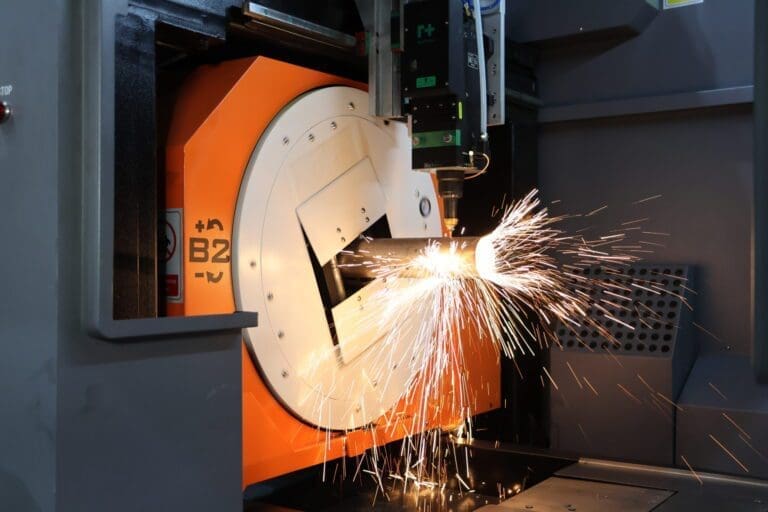
UTE’s combo laser systems incorporate specialized tube-cutting capabilities along with large-diameter pneumatic chucks featuring automatic centering and adjustable clamping force to support accurate tube processing.
2. Workholding Complexity
Sheet lasers typically rely on:
- Cutting beds
- Slat systems
- Shuttle tables
Tube lasers require:
- Chucks
- Supports
- Rotational positioning systems
When combining both technologies, engineers must create a platform capable of:
- Rapid mode switching
- Stable material positioning
- High accuracy in multiple geometries
This is one reason many manufacturers evaluate true integrated systems rather than aftermarket attachments.
UTE specifically describes the PHTUS3015 as a complete sheet and tube cutting solution rather than simply a sheet laser with a tube attachment.
3. Software Integration
One of the most overlooked challenges is software.
A successful automated workcell requires:
- CAD import
- Part programming
- Nesting
- Tube profiling
- Job scheduling
- Production monitoring
When separate software environments are required for sheet and tube operations, complexity increases dramatically.
Leading automation strategies focus on:
- Unified programming environments
- Shared job databases
- Integrated production scheduling
- Cross-machine performance visibility
4. Automated Material Flow
Laser cutting speed often isn’t the real bottleneck.
Material movement is.
Even high-performance lasers lose productivity when operators spend time:
- Loading raw material
- Unloading parts
- Moving cut components
- Sorting work orders
UTE’s automation integration services focus on custom robotic solutions, automated loaders, platforms, and pick-and-place systems designed to fit directly within the customer’s production environment.
For many manufacturers, the automation surrounding the laser ultimately creates more throughput gains than additional laser power alone.
The Human Challenge: Labor and Workforce Constraints
Automation discussions often focus entirely on technology.
In reality, workforce limitations are one of the strongest drivers behind automation investments.
Many fabrication plants face:
- Skilled labor shortages
- Increased training requirements
- High turnover rates
- Rising labor costs
Integrated automation helps by:
- Reducing repetitive handling tasks
- Standardizing workflow execution
- Lowering dependence on manual machine tending
- Improving repeatability across shifts
The result is often better operational stability in addition to productivity improvements.
Evaluating a Combo Laser vs. Separate Machines
Every manufacturing environment is unique.
There is no universal answer regarding whether a combo laser or separate systems are best.
The decision should be based on production requirements.
Choose a Combo Laser When:
Product Mix Is Highly Diverse
A combo system is often ideal for:
- Job shops
- Contract manufacturers
- Prototype environments
- Medium-volume fabrication
These operations benefit from flexibility more than extreme specialization.
Floor Space Is Limited
Combining two processes into one machine can significantly reduce footprint requirements.
UTE highlights reduced floor-space consumption as one of the primary benefits of its integrated sheet-and-tube platform.
Capital Efficiency Matters
Rather than purchasing:
- A dedicated sheet laser
- A dedicated tube laser
- Additional automation
A combo solution may achieve production goals with a smaller initial investment.
UTE positions its integrated design as a highly cost-effective approach for fabricators needing both capabilities.
Choose Dedicated Systems When:
Sheet and Tube Production Are Both Extremely High Volume
If both operations run continuously, dedicated machines may provide greater overall throughput.
Separate Departments Already Exist
Large manufacturers with mature workflows may gain greater productivity from specialized processing cells.
Growth Plans Include Multiple Shifts
Dedicated equipment can offer more parallel processing opportunities in high-output environments.
Automation Features That Matter Most
When evaluating automated laser workcells, manufacturers should focus on the following capabilities.
Exchange Tables
Fast exchange platforms reduce idle machine time during loading and unloading.
UTE’s combo laser incorporates an exchange platform designed to accelerate material changeovers and maximize productivity.
Intelligent Material Loading
Automated loading systems can:
- Reduce labor requirements
- Improve safety
- Increase machine utilization
Look for systems capable of scaling as production volumes increase.
Robotic Integration
The most successful automation strategies consider the entire workcell.
UTE develops custom robotic automation using major robot platforms including Yaskawa, Fanuc, Mitsubishi, and Denso, with solutions tailored to specific production requirements.
Dust and Fume Management
As cutting volumes increase, extraction efficiency becomes more important.
UTE’s combo system utilizes a multi-zone exhaust approach designed to improve dust removal performance compared to traditional center-exhaust configurations.
Questions Every Fabricator Should Ask Before Buying
Before selecting a sheet and tube laser automation solution, decision makers should ask:
- What percentage of our work is sheet versus tube?
- How much floor space is available?
- What level of unattended operation do we require?
- How many operators can realistically be assigned?
- What downstream processes must be integrated?
- Will future growth require robotic handling?
- Can the software support both sheet and tube workflows?
- What training and support resources are available?
UTE emphasizes installation, training, technical support, inventory availability, and nationwide service coverage as key factors supporting long-term machine success.
The Future of Automated Fabrication Workcells
The future of metal fabrication is increasingly centered around connected, flexible manufacturing systems capable of handling multiple product types with minimal manual intervention.
Rather than optimizing individual machines, leading manufacturers are now optimizing entire workflows.
Integrated sheet and tube laser automation enables fabricators to:
- Reduce material handling
- Improve machine utilization
- Increase production flexibility
- Expand available services
- Simplify workcell management
- Respond more quickly to changing customer demands
As solutions like the PHTUS3015 Combo Laser demonstrate, the industry is moving beyond isolated machines and toward multifunction production systems that combine sheet and tube capabilities into a unified manufacturing platform.
Final Thoughts
For manufacturers evaluating automated laser cutting equipment, the most important decision is not simply choosing a laser. It is choosing a workflow.
The most successful investments align machine capabilities, material flow, automation strategy, software integration, and workforce realities into a cohesive production system. By carefully evaluating throughput requirements, floor space constraints, material mix, and automation goals, fabricators can determine whether an integrated sheet-and-tube workcell provides the flexibility and productivity needed to remain competitive in an increasingly demanding manufacturing landscape.